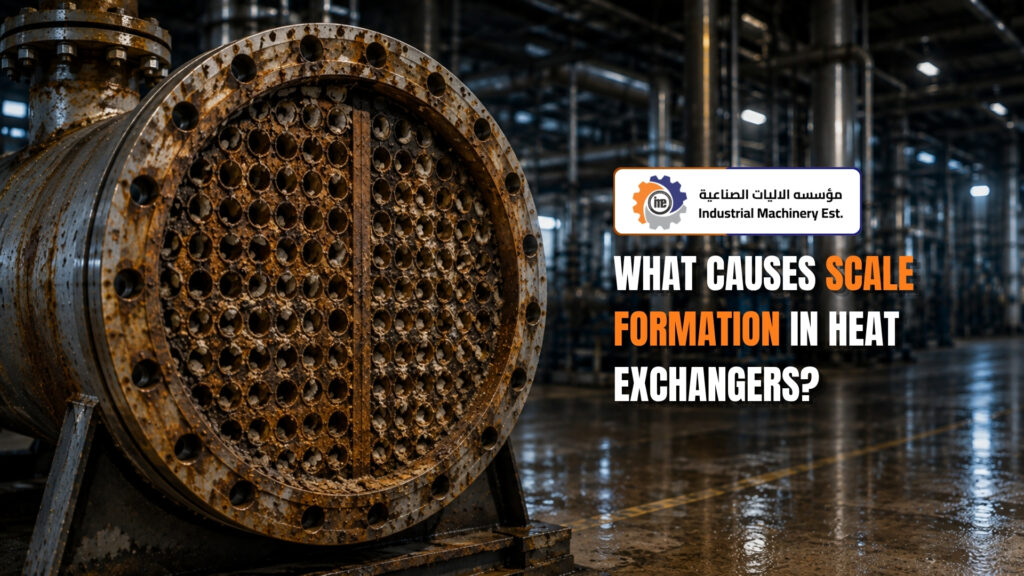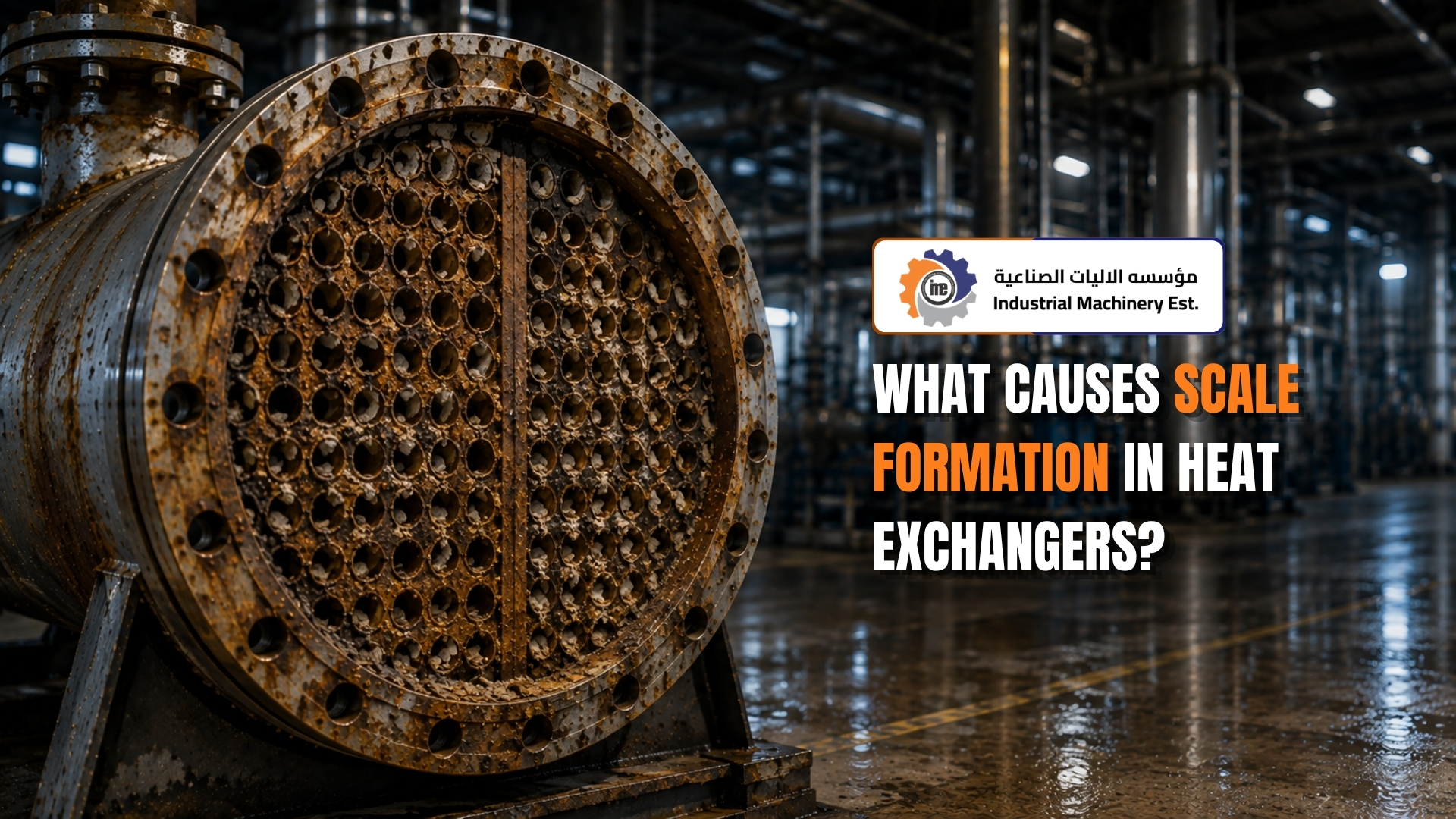
Your exchanger was hitting design duty six months ago. Now outlet temperatures are drifting, pressure drop is climbing, and the energy bill keeps rising. The cause is usually a thin, chalky layer baked onto the inside of the tubes. Scale formation happens when dissolved minerals fall out of solution and crystallise on hot metal, and even a paper thin deposit can cut heat transfer sharply.
Hard water, high surface temperature, low flow velocity, and poor chemical control are what drive scale formation in heat exchangers. Control those four and the problem largely goes away. Read on for the full breakdown of causes, warning signs, prevention, and removal.
Industrial Machinery Est. Heat Exchanger Services
What Scale Formation Actually Is
Scale formation is a specific type of fouling. It is not silt, rust debris, or biological slime. It is the crystallisation of dissolved salts, mainly calcium carbonate, calcium sulphate, magnesium compounds, and silica, onto the heat transfer surface.
These salts have inverse solubility: they become less soluble as water gets hotter. That is why scale formation always attacks the hottest part of the unit first, normally the tube wall on the water side.
Hard Water Is the Root Cause
Most cases of scale formation in heat exchangers start with the water itself. Cooling water, boiler feed water, and seawater all carry dissolved calcium and magnesium ions.
When that water is heated or concentrated through evaporation, those ions pass their solubility limit and precipitate. The harder the water, the faster scale formation takes hold. Plants running high cycles of concentration on cooling towers see scale formation accelerate very quickly.
Surface Temperature Drives the Reaction
Metal temperature is the second major trigger. The hotter the wall, the thinner the boundary layer where water turns supersaturated, and the quicker crystals anchor.
Scale formation in heat exchangers is far more aggressive on high duty exchangers, reboilers, and condensers than on low temperature service. This is why identical water quality can cause severe scale formation in one unit and almost none in another sitting a few metres away.
Low Velocity and Dead Zones
Turbulence keeps minerals suspended. When velocity drops below design, particles settle and crystals get time to bond to the surface.
Scale formation is always worst in dead legs, bypassed passes, oversized units running at part load, and equipment that sits idle between campaigns. Partially blocked tubes then create a loop: less flow, more deposit, then even less flow.
Water Chemistry Out of Control
pH, alkalinity, and inhibitor dosing decide whether minerals stay dissolved. Alkaline water pushes calcium carbonate out of solution and accelerates scale formation across the whole bundle.
If antiscalant dosing drifts or the treatment programme is not monitored, scale formation in heat exchangers restarts within weeks. Rough or corroded tube walls give crystals somewhere to grip, which is why corrosion and scale formation usually turn up together.
Common Scale Types You Will Find
- Calcium carbonate: the most common deposit, white and chalky, dissolves readily in inhibited acid.
- Calcium sulphate: harder and denser, often found in seawater and high temperature service.
- Magnesium salts: usually mixed with carbonate deposits in hard water systems.
- Silica: the toughest of all, resists normal acids and often needs mechanical removal.
- Iron oxide: red brown deposit that signals an underlying corrosion problem.
What Scale Formation in Heat Exchangers Costs Your Plant
- Lost heat transfer: a deposit under one millimetre thick can reduce efficiency by a quarter or more.
- Higher pressure drop: narrowed tubes force pumps to work harder for less throughput.
- Extra fuel and power: the unit burns more energy to reach the same outlet temperature.
- Hot spots and tube failure: insulated metal overheats locally and cracks.
- Unplanned shutdowns: a fouled exchanger can force an early turnaround.
Early Warning Signs to Watch
- Rising approach temperature between shell and tube side.
- Increasing differential pressure at steady flow.
- Falling throughput or reduced cooling capacity.
- Chalky white residue on removed tube bundles or plates.
- Water analysis showing rising hardness or alkalinity.
How to Prevent Scale Formation in Heat Exchangers
Preventing scale formation costs far less than recovery. Pretreat make up water with softeners, demineralisers, or reverse osmosis to strip out the minerals that cause scale formation in the first place.
Keep an active water treatment programme with antiscalants and threshold inhibitors. Hold pH and cycles of concentration inside a safe band, maintain turbulent flow through every pass, and trend approach temperature and pressure drop so scale formation in heat exchangers is caught early rather than discovered during a shutdown.
Removing Scale Once It Has Formed
Chemical cleaning is the fastest route. Circulating inhibited acid or a citric based descaler through the unit dissolves the deposit without dismantling it, and the inhibitor protects the base metal. Clean in place methods keep downtime to a minimum.
Where deposits are silica based or extremely hard, mechanical cleaning by hydrojetting or tube brushing is the reliable option. Many plants combine both.
Industrial Machinery Est. provides chemical cleaning, hydrojetting, and complete heat exchanger services across the Kingdom, helping operators restore lost efficiency and keep scale formation under control. Contact our team for a site assessment.