
Plate Heat Exchanger Services in Saudi Arabia
A plate heat exchanger transfers more heat per square metre of floor space than almost any other design, which is exactly why fouling, a failed gasket or a single cracked plate shows up in your production numbers so quickly. Industrial Machinery Est. has kept this equipment running since 1990 from our base in Jubail Industrial City.
We clean, overhaul, regasket, repair and supply plate heat exchanger units for petrochemical, refining, oil and gas, power, desalination and marine facilities across Saudi Arabia. As an approved vendor for Saudi Aramco, SABIC, Tasnee and Marafiq, our crews work to client procedures and hand over full inspection and hydrotest documentation on completion.
One Partner for Service, Cleaning and Spares
Most plants deal with one contractor for cleaning, a second for spare plates and a third for replacement units. That split costs time during a shutdown, when the unit is already open and the clock is running. Industrial Machinery Est. covers all three scopes, so a single team inspects the unit, tells you what it needs and delivers it.
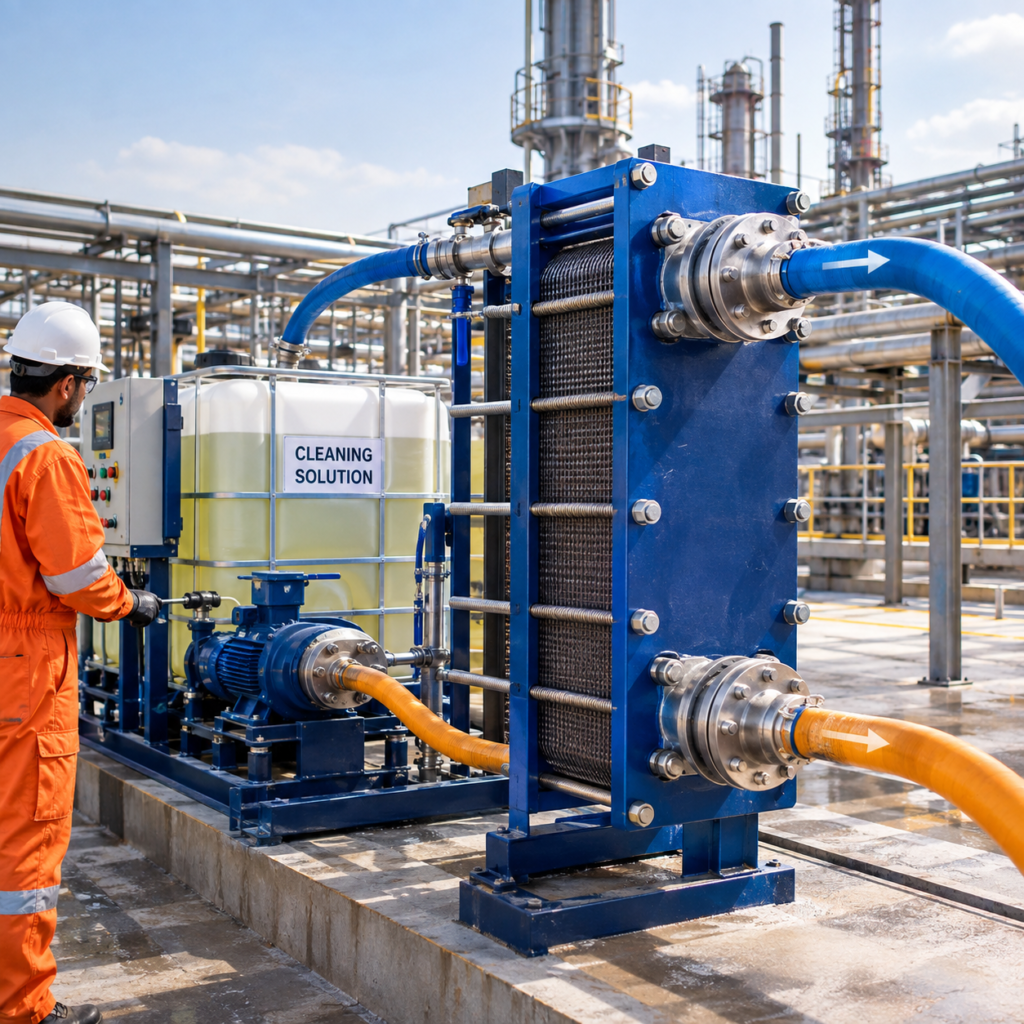
Plate Heat Exchanger Cleaning and Overhauling
Regasketing, Plate Repair and Testing
Plate Heat Exchanger Parts and Spares
We supply plate heat exchanger parts for major brands and for units where the original supplier is no longer active in the Kingdom. Stocked and sourced items include:
- Pressed plates in stainless steel, titanium, SMO 254 and Hastelloy
- Gaskets in EPDM, NBR, Viton and PTFE-faced compounds
- Frame plates, pressure plates and connection liners
- Carrying bars, guide bars, support columns and roller assemblies
- Tightening bolts, bearing boxes, nozzles and studded ports
- Adhesives and gasket glue for onsite regasketing crews
Plate Type Heat Exchanger Models We Handle
Our teams work across the full range of plate designs found in Saudi process and utility plants:
- Gasketed units, the standard removable plate type heat exchanger used for cooling water, lube oil and interchanger duties
- Brazed units, compact and gasket free, common in HVAC, chillers and small process skids
- Semi-welded and fully welded packs for refrigerants, aggressive media and higher operating pressures
- Plate and shell heat exchanger units, where a welded plate pack sits inside a pressure shell for high temperature and high pressure steam and condensing service
- Plate fin heat exchanger blocks in brazed aluminium, used in cryogenic, air separation and gas processing applications
- Plate evaporators, condensers and heat recovery packs in desalination and utility systems
A plate and shell heat exchanger cannot be opened like a gasketed frame, so it is serviced by chemical circulation, borescope inspection and pressure testing rather than dismantling. A plate fin heat exchanger needs an even more controlled approach because of the thin aluminium fins, and we scope those cases individually before any chemistry touches the block.