Your plate heat exchanger looks fine on paper. The pumps run normally, yet the outlet temperature keeps missing its target. Cleaning helps for a few weeks, and then the problem comes back.
In many cases, the cause sits inside the plate pack: a corrugation pattern, chevron angle, or plate geometry that no longer suits the duty. This mismatch quietly raises energy use, pressure drop, and fouling, and it can push a whole process unit off its design limits.
Summary
Plate design affects heat transfer efficiency by controlling how much turbulence the fluid creates as it flows between the plates. The corrugation pattern, chevron angle, plate length, channel gap, and flow distribution together decide three things:
- How Fast Heat Moves?
- How Much Pressure is Lost?
- How Quickly the Plates Foul?
The best design gives high heat transfer at a pressure drop your system can accept.
Why Plate Design Matters More Than Plate Size
Two plate heat exchangers can have the same heat transfer area and still perform very differently. The reason is simple. The metal plate itself is thin and passes heat easily. The real barrier is the thin layer of slow-moving fluid that sticks to the plate surface, called the boundary layer.
The main job of plate design is to break up this layer. A well-designed plate keeps the fluid moving and mixing, so heat reaches the metal faster.
Plate design directly controls:
- Heat transfer coefficient: how much heat moves per square meter of plate
- Pressure drop: how much pump energy is needed to push fluid through
- Fouling rate: how fast deposits build up on the plate surface
- Mechanical strength: how well the plates handle operating pressure
- Cleaning needs: how often the unit must be opened or flushed
How Corrugation Patterns Create Turbulence
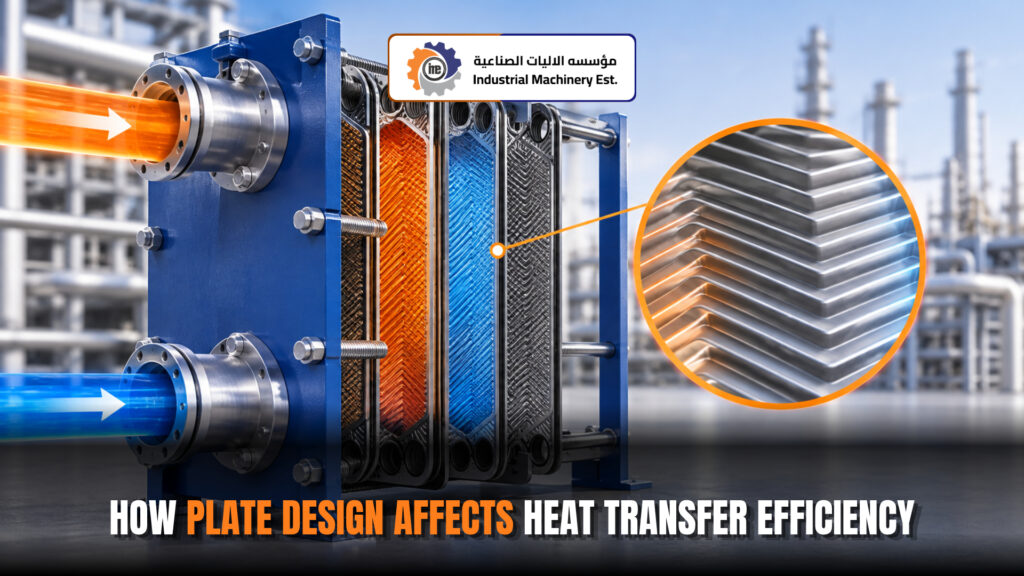
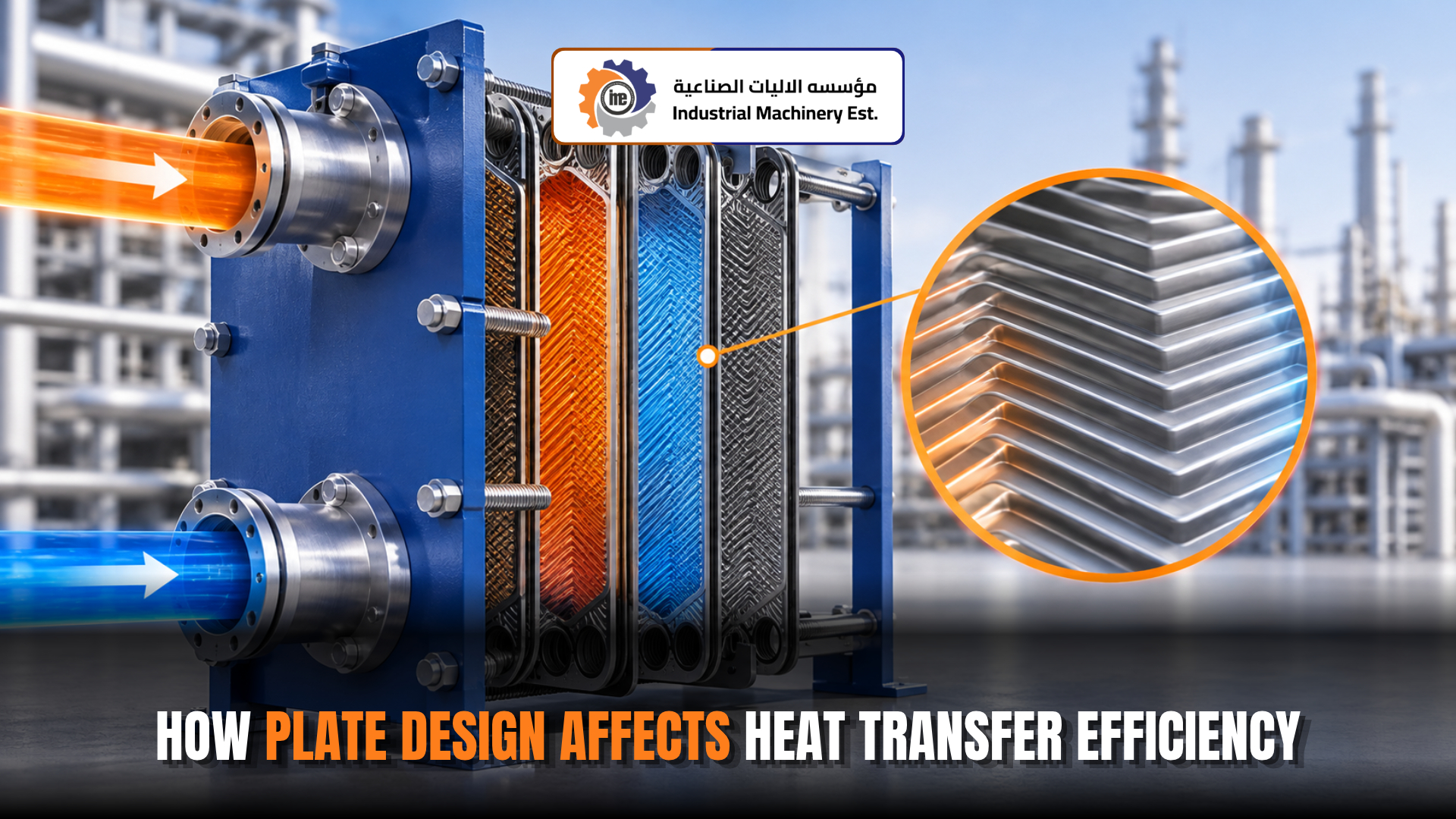
Corrugations are the pressed waves on the surface of each plate. When plates are stacked, the waves on one plate cross the waves on the next, forming narrow channels with a complex path. The fluid is forced to change direction constantly, which creates swirling flow.
Common corrugation patterns:
- Chevron (herringbone): The most widely used pattern. It has V-shaped ridges that create strong turbulence and many contact points between plates.
- Washboard: Parallel waves across the plate. It gives a more open flow path with lower turbulence.
- Asymmetric patterns: Different channel sizes on each side of the plate. These suit duties where the hot and cold flow rates are very different.
What corrugations do for performance:
- Break up the boundary layer so heat moves faster
- Add extra surface area, usually around 10 to 25 percent more than a flat plate
- Create contact points that support the plates against pressure differences
- Spread the flow across the full plate width
Chevron Angle: The Main Trade-Off Between Heat Transfer and Pressure Drop
The chevron angle is the angle of the V-shaped ridges relative to the direction of flow. It is one of the most important choices in plate design because it sets the balance between heat transfer and pressure drop.
Note: some manufacturers measure the angle from the horizontal instead of the flow direction. Always confirm which method your supplier uses before comparing plates.
| Plate type | Typical chevron angle | Heat transfer | Pressure drop | Best suited for |
| High angle (“hard” plate) | Around 60 to 65 degrees | High | High | Close temperature approach, clean and thin fluids, limited space |
| Low angle (“soft” plate) | Around 25 to 30 degrees | Lower | Low | High flow rates, thick fluids, tight pressure drop limits |
| Mixed plates | Combination of both | Medium | Medium | Fine-tuning performance between the two |
Key point: a higher chevron angle is not always better. It raises heat transfer, but pressure drop rises much faster. If your pumps cannot supply that extra pressure, flow drops and the gain in heat transfer is lost. Mixing high-angle and low-angle plates in one pack lets designers hit the exact thermal duty without wasting pump energy.
Plate Geometry: Length, Gap, Thickness, and Ports
Beyond the corrugation pattern, the physical shape of the plate has a strong effect on performance.
- Plate length: Longer plates give the fluid more time in contact with the surface. This suits duties with a close temperature approach. Shorter plates give lower pressure drop but less heat recovery per pass.
- Plate width: Wider plates handle higher flow rates, but the flow must be spread evenly across the full width to use all of the area.
- Channel gap (pressing depth): A narrow gap raises fluid velocity and heat transfer, but it can block with fibers or solids. Wide-gap plates suit slurries, pulp, and dirty fluids.
- Plate thickness: Thinner plates pass heat slightly better, but thicker plates handle higher pressures and resist damage. Most plates fall between 0.4 and 1.0 mm.
- Port size: Small ports limit total flow and can cause high inlet velocity, uneven distribution, and erosion near the port area.
- Plate material: Stainless steel suits most water and chemical duties. Titanium is common for seawater. Special alloys are used for strong acids and chlorides. Material choice affects corrosion life more than heat transfer.
Flow Distribution: Getting Every Channel to Do Its Share
A plate heat exchanger only performs well if fluid reaches every part of every plate. Poor distribution leaves areas of the plate doing little or no work.
Distribution happens at two levels:
- Across each plate: The area near the inlet port has a special pattern, often called the distribution zone. It spreads the incoming fluid across the full plate width. If this zone is poorly designed or partly blocked, the edges of the plate receive little flow.
- Across the plate pack: In large packs, channels near the inlet can receive more flow than channels at the far end. The connection arrangement and the number of passes affect how evenly flow is shared.
Effects of poor flow distribution:
- Dead zones where fluid barely moves
- Hot spots and uneven outlet temperatures
- Faster fouling in low-flow areas
- Lower effective heat transfer area than the design value
Turbulence: Why Plate Exchangers Outperform Tube Designs
In a straight pipe, flow usually needs a high velocity to become turbulent. In a plate heat exchanger, the corrugations force turbulence at much lower flow rates. This is why plate heat exchangers often reach heat transfer coefficients three to five times higher than shell and tube units for the same duty.
Benefits of high turbulence:
- Smaller unit size for the same heat load
- Closer temperature approach between the two fluids
- Less fluid volume held inside the exchanger
- A scrubbing effect that slows deposit buildup
The cost of turbulence:
- Higher pressure drop
- More pump energy
- Greater sensitivity to particles in narrow channels
How Plate Design Influences Fouling and Cleaning Intervals
Fouling is one of the biggest causes of lost efficiency, and plate design has a direct effect on it.
- High wall shear slows fouling. Fast, turbulent flow scrubs the plate surface and makes it harder for deposits to stick.
- Low-velocity zones foul first. Corners, edges, and areas behind poor distribution zones collect scale and sludge.
- Oversizing can backfire. Adding too much extra plate area as a safety margin lowers fluid velocity. Lower velocity can speed up fouling, so the extra area is lost faster than expected.
- Narrow gaps trap solids. Fluids with fibers or particles need wide-gap plates to avoid blockage.
Regular cleaning, either by chemical cleaning in place (CIP) or by opening the unit for mechanical cleaning, restores the plate surface. However, if a unit fouls very quickly after every cleaning, the plate design itself may no longer suit the process.
Pressure Drop, Energy Use, and Overall Operating Efficiency
Heat transfer and pressure drop do not rise at the same rate. When fluid velocity increases, pressure drop climbs much faster than heat transfer. This means every design gain must be checked against the energy cost of pumping.
Points to consider:
- Every system has an allowable pressure drop set by the pumps and the process.
- A unit that uses its full pressure drop budget on heat transfer leaves no margin for fouling.
- As plates foul, pressure drop rises and flow falls, which reduces heat transfer even further.
- The most efficient design is the one that meets the thermal duty at the lowest total operating cost, not the one with the highest heat transfer coefficient.
Warning Signs Your Plates Are Limiting Performance
Watch for these signs during operation:
- Outlet temperature slowly drifting away from the design value
- Pressure drop rising steadily between cleanings
- Uneven surface temperatures across the plate pack
- Cleaning needed more often than before
- Gasket leaks or fluid mixing between the hot and cold sides
- Visible plate damage, corrosion, or deformation during inspection
Any of these signs can point to fouling, plate damage, gasket failure, or a plate design that no longer matches the current operating conditions.
How to Match Plate Design to Your Application
- Define the duty clearly. List flow rates, inlet and outlet temperatures, and the allowable pressure drop on both sides.
- Know your fluids. Check viscosity, solids content, fouling tendency, and corrosiveness.
- Select the chevron angle. Use high-angle plates for clean fluids and close approaches. Use low-angle or mixed plates when pressure drop is limited.
- Choose the channel gap. Standard gaps suit clean fluids. Wide gaps suit slurries and fibrous fluids.
- Pick the right plate length and material. Match length to the temperature program and material to the corrosion risk.
- Avoid excess margin. Size for the real duty and plan a cleaning schedule instead of adding large amounts of extra area.
- Re-check after process changes. If flow rates or fluids change, have the plate arrangement re-rated.
Plate Heat Exchanger Services from Industrial Machinery Est.
Even a well-designed plate heat exchanger loses efficiency without proper care. Industrial Machinery Est. is a trusted provider of plate heat exchanger services in Saudi Arabia, helping plants keep their units running close to design performance.
Based in Jubail Industrial City since 1990, Industrial Machinery Est. holds approved vendor status with Saudi Aramco, SABIC, Tasnee, and Marafiq. The company supports petrochemical, oil and gas, refining, power, and marine facilities.
Plate heat exchanger services include:
- Inspection: Checking plates for fouling, corrosion, cracks, and deformation
- Cleaning: Chemical cleaning in place (CIP) and mechanical cleaning to restore heat transfer surfaces
- Repair: Correcting leaks, damaged plates, and sealing problems
- Maintenance: Planned service to extend run time between shutdowns
- Spare parts: Supply of replacement plates, gaskets, and related components
With over 30 years of experience and more than 100 major projects, Industrial Machinery Est. helps clients get reliable and efficient heat exchanger performance in demanding industrial conditions.