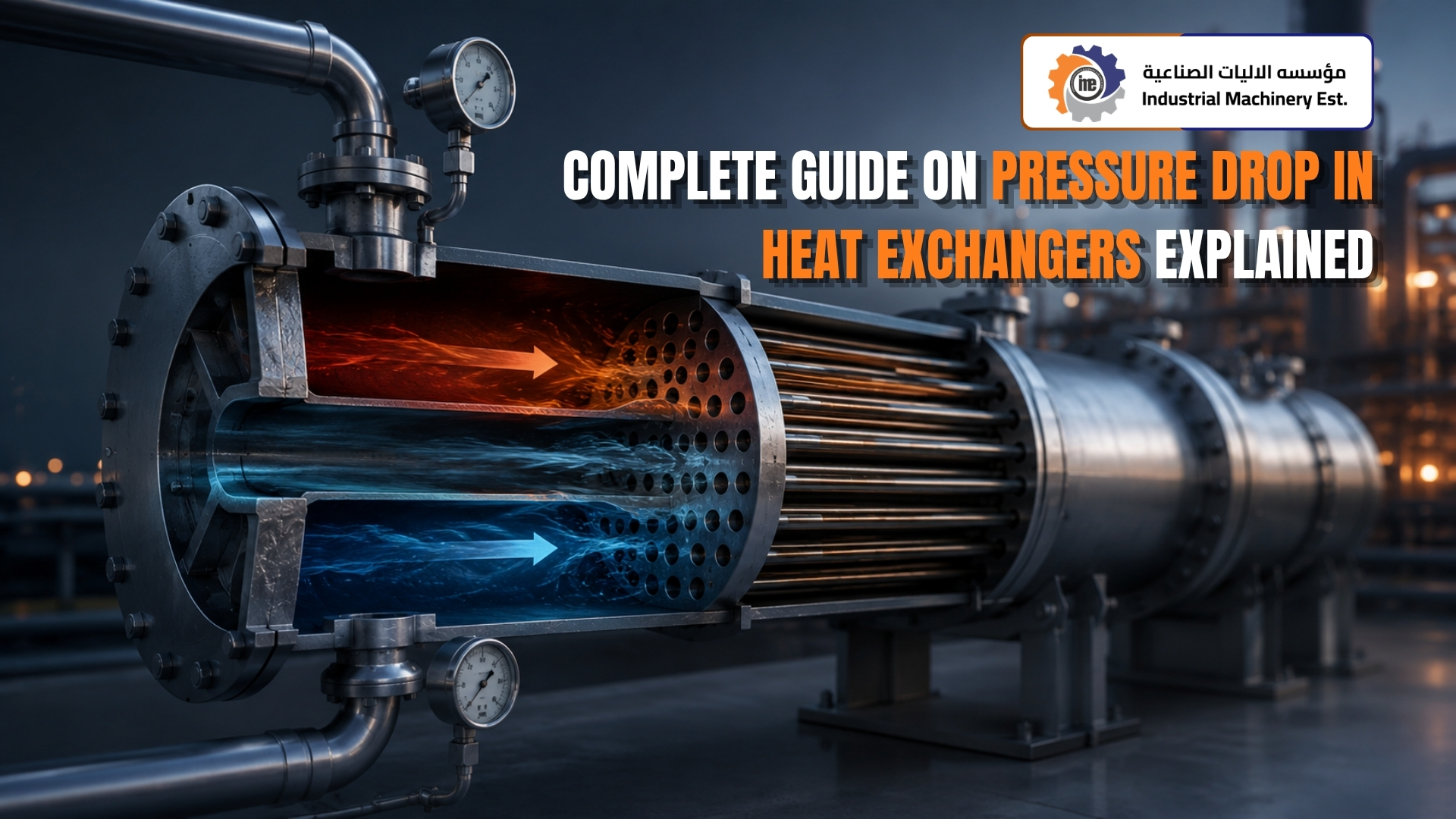
Rising pump costs, unexpected shutdowns, and heat exchangers that suddenly stop performing the way they used to are frustrating problems that many plant engineers face. Most of the time, the root cause traces back to one thing: excessive pressure drop in heat exchangers. When it climbs too high, pumps work harder, energy bills rise, and fouling builds up faster than expected.
If you want short conclusion it’s when pressure drop happens because fluid loses energy to friction as it moves through tubes, baffles, and fittings. Keeping it within the designed range depends on managing flow velocity, tube geometry, fouling, and baffle spacing. If you want the full picture, including causes, calculation basics, and practical ways to reduce it, keep reading below.
What Is Pressure Drop in Heat Exchangers?
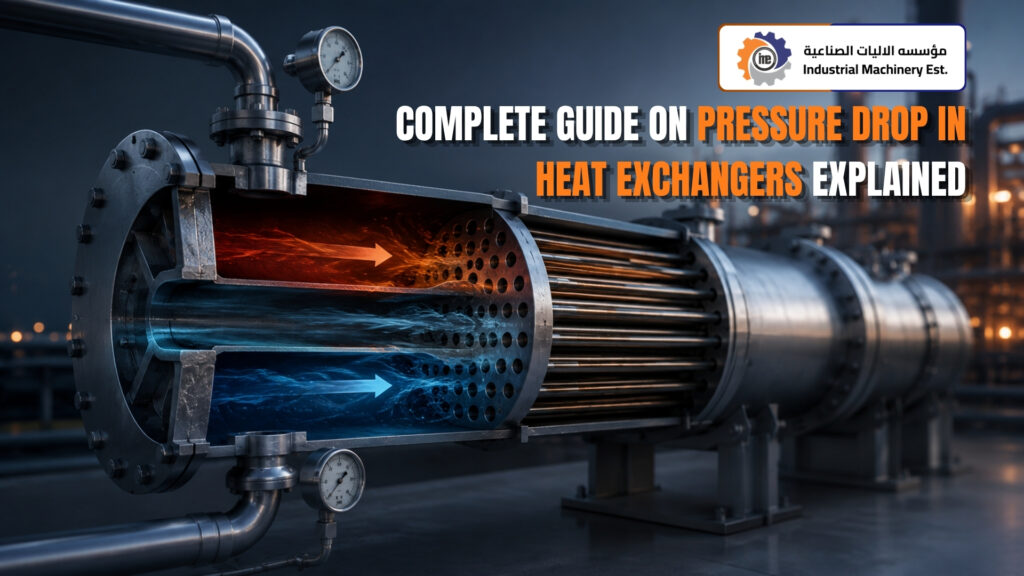
Pressure drop in heat exchangers refers to the loss of fluid pressure as it travels from the inlet to the outlet of the unit. It is usually written as ΔP and measured in units like psi, bar, or kPa.
This drop happens because fluid has to overcome resistance from tube walls, bends, baffles, and internal fittings. Some pressure loss is normal and even necessary, since it indicates that fluid is moving fast enough to transfer heat efficiently. The concern begins when pressure drop in heat exchangers goes beyond the design limit.
Why Pressure Drop Matters
Pressure drop is not just a number on a datasheet. It directly affects operating costs, equipment life, and process reliability. A few reasons it deserves attention include:
- Pumping costs: A higher reading means pumps or compressors need more power to push fluid through.
- Energy efficiency: Excess resistance wastes energy without adding any real heat transfer benefit.
- Equipment stress: An elevated reading can strain tubes, gaskets, and seals over time.
- Process stability: Sudden shifts often signal fouling or blockages forming inside the unit.
Because of these effects, pressure drop in heat exchangers is tracked closely during both design and daily operation.
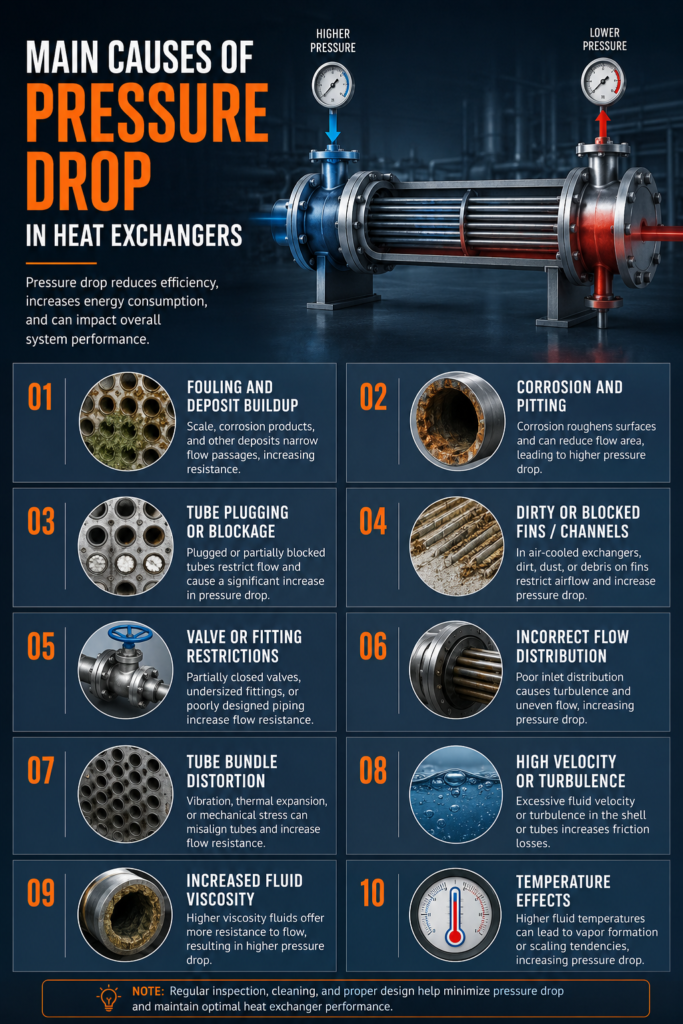
Main Causes of Pressure Drop in Heat Exchangers
Several factors combine to create pressure drop inside a heat exchanger. Understanding each one makes it easier to diagnose problems early.
Friction along tube and shell surfaces
As fluid moves through tubes or across the shell side, it rubs against internal surfaces. This friction is the single biggest contributor to overall resistance, and it increases with rougher surfaces and higher flow velocity.
Flow velocity
Faster flow improves heat transfer, but it also raises the pressure loss across the unit. Engineers must balance velocity carefully so the exchanger transfers heat well without pushing pressure drop past acceptable limits.
Tube and shell geometry
Smaller tube diameters, longer tube lengths, and tighter baffle spacing all increase resistance to flow. These design choices affect the overall pressure loss just as much as the fluid properties themselves.
Fouling and scaling
Deposits that build up on internal surfaces narrow the flow path over time. This is one of the most common reasons pressure drop in heat exchangers rises gradually during normal operation, often long before any efficiency loss becomes obvious. Regular monitoring of fouling trends can also extend the service life of tube bundles, gaskets, and other internal components well beyond their typical replacement schedule.
Fluid viscosity and density
Thicker fluids naturally resist flow more than thin ones. Viscosity changes with temperature also mean pressure drop can shift as the process heats up or cools down.
How Pressure Drop Is Calculated
Calculating pressure drop in heat exchangers involves several variables, including flow rate, fluid density, viscosity, tube diameter, tube length, and surface roughness. Engineers typically rely on established correlations for tube-side and shell-side flow, since each side behaves differently.
The tube side is generally easier to estimate because flow moves in a straight, predictable path. The shell side is more complex due to baffle spacing, cross-flow patterns, and leakage paths around baffles and tube bundles. Most designers use simulation software rather than manual formulas for accuracy, especially on larger industrial units where dozens of variables interact at once.
Acceptable Pressure Drop Ranges
There is no single number that applies to every application. That said, a commonly used guideline suggests:
- Liquids: around 5 to 10 psi is often acceptable, depending on the process.
- Gases: typically lower, around 1 to 3 psi, since gas pressure changes affect volume more significantly.
- Condensers and vaporizers: usually kept even lower to avoid disrupting phase change behavior.
These figures are only starting points. The actual allowable pressure drop in heat exchangers should always be confirmed against process requirements and pump or compressor capabilities, since every system has its own tolerance for pressure drop.
Check Also: Top 7 Causes of Tube Fouling in Heat Exchangers
How to Reduce Pressure Drop in Heat Exchangers
If pressure drop is running higher than expected, a few practical steps can help bring pressure drop back under control:
- Clean regularly: Routine cleaning removes fouling deposits before they narrow flow paths significantly.
- Adjust baffle spacing: Wider spacing on the shell side can lower resistance without sacrificing too much heat transfer.
- Review tube layout: Increasing tube diameter or reducing tube length, where possible, eases flow resistance.
- Monitor flow velocity: Keeping velocity within recommended ranges prevents unnecessary pressure loss.
- Inspect for blockages: Partial obstructions from debris or scale can cause sudden spikes in resistance across the unit.
What is a normal pressure drop for a heat exchanger?
It depends on the fluid type. Liquids usually run around 5 to 10 psi, gases typically stay lower at 1 to 3 psi, and condensers or vaporizers are kept even lower to protect phase change behavior. The right number always depends on the specific process and pump or compressor capacity.
Why does pressure drop increase over time in a heat exchanger?
The most common reason is fouling. As deposits build up on tube and shell surfaces, the flow path narrows, forcing fluid to push harder to move through. This gradual rise is often the earliest warning sign of fouling, sometimes appearing before any noticeable drop in heat transfer efficiency.
Can pressure drop be too low?
Yes. Some pressure drop is actually necessary, since it reflects fluid moving fast enough to transfer heat effectively. If pressure drop is unusually low, it can mean flow velocity is too weak, which often results in poor heat transfer and increased risk of fouling due to sluggish, low turbulence flow.
In the End
Pressure drop in heat exchangers is an unavoidable part of how these units function, but it should never be ignored. Tracking it closely helps catch fouling, design flaws, or operational issues before they turn into costly downtime. With regular monitoring, proper cleaning schedules, and sound design choices, it can be kept within a range that supports both efficient heat transfer and lower operating costs over the long run.