Outlet temperatures drifting off design, pressure drop climbing every month, more fuel burned for the same duty. These are the first signals that scale has taken over your tubes. Brushing and jetting cannot always reach narrow tubes or tight plate packs, and pulling a unit apart costs days of production.
Acid cleaning of heat exchangers fixes this by dissolving the deposit chemically, usually without opening the equipment. With the correct acid and a corrosion inhibitor, heat transfer comes back in hours. The full detail is below.
What Acid Cleaning of Heat Exchangers Actually Does
Most fouling in water-cooled equipment is mineral scale: calcium carbonate, calcium sulphate, iron oxide, and silica. These layers behave like insulation on the tube wall. Even a thin scale layer can noticeably reduce heat transfer and raise energy cost.
Acid cleaning of heat exchangers works by converting those hard deposits into a soluble form so they drain out as liquid instead of being scraped away by hand.
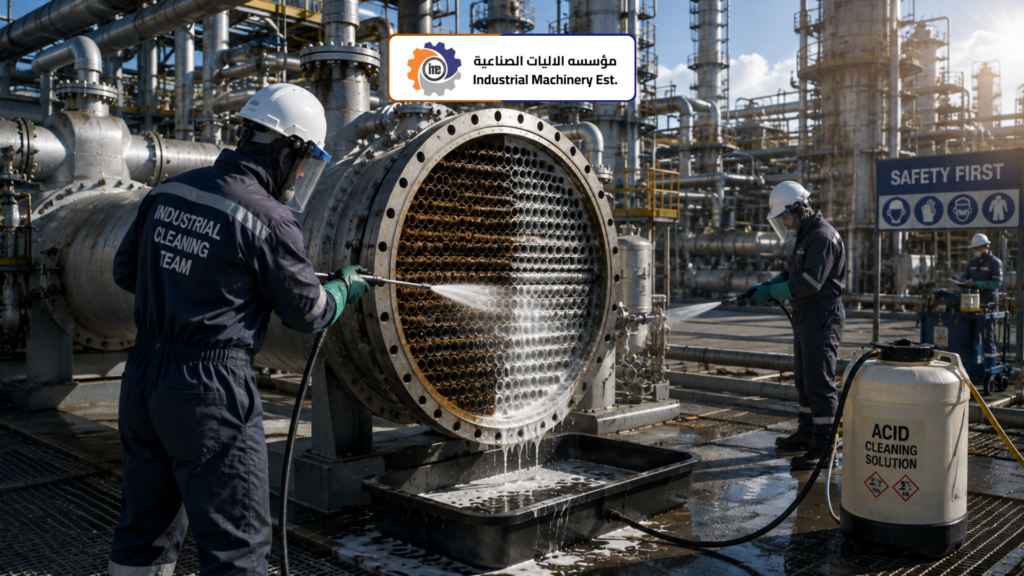
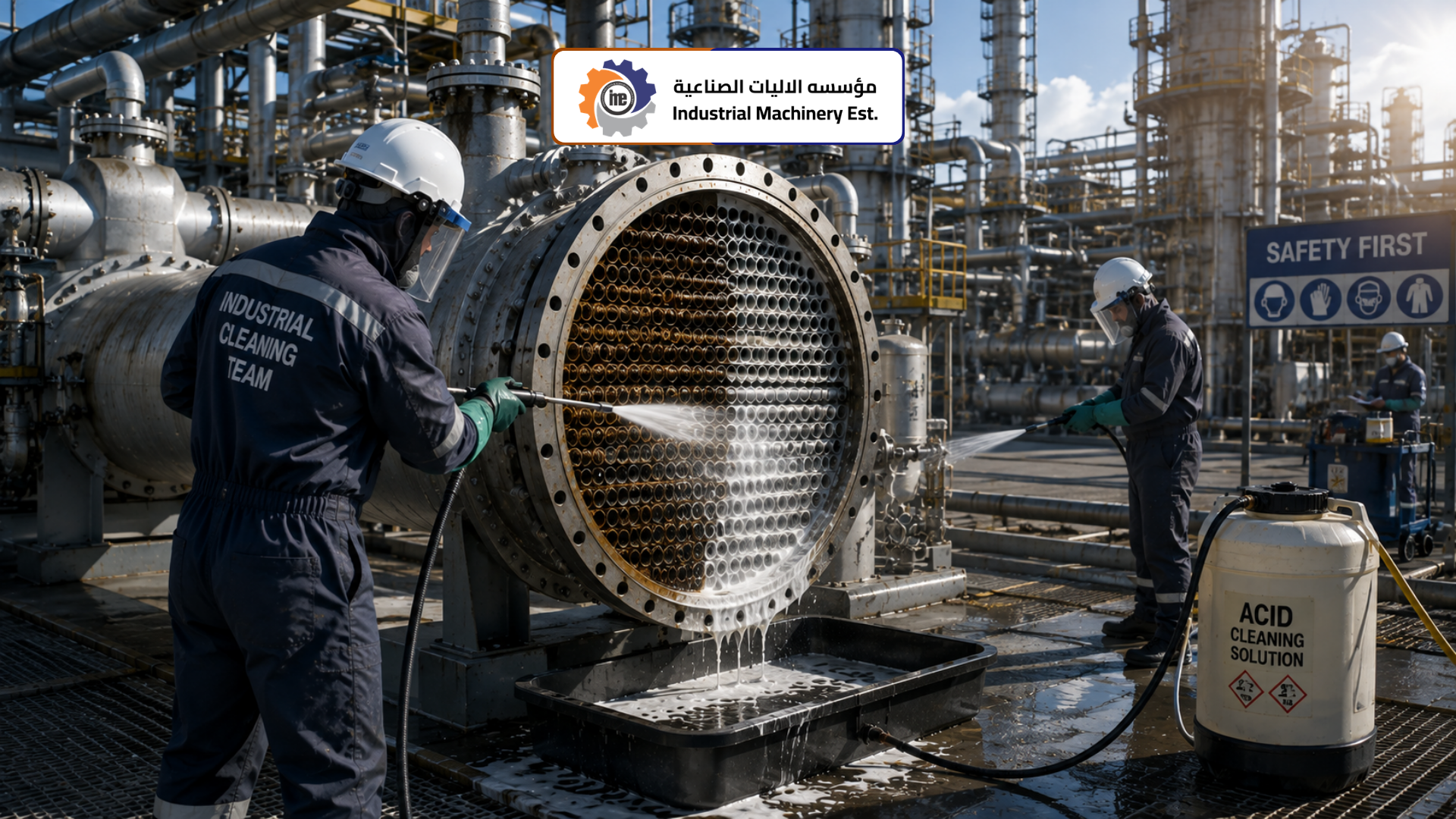
The job is normally done as a circulation exercise. A pump, tank, and hoses form a temporary loop around the unit, and a heated acid solution is circulated through the tube side or shell side. This is often called cleaning in place, because the exchanger stays bolted up and connected.
Signs Your Exchanger Needs Acid Cleaning
- Outlet temperature moving away from design values
- Pressure drop across the unit rising steadily
- Cooling water flow falling with no pump fault
- Higher steam or fuel consumption for the same output
- Reduced throughput or repeated high-temperature trips
When two or more of these show up together, plan acid cleaning early. Old scale hardens and becomes far harder to dissolve later.
Choosing the Right Acid for the Deposit
There is no universal chemical. Selection depends on the deposit type and, just as importantly, on the tube metallurgy.
- Hydrochloric acid
- Sulphamic acid
- Citric acid
- Phosphoric acid
Copper, titanium, duplex, and stainless all react differently, so material compatibility must be confirmed against NACE International corrosion control standards before any dosing begins.
The Acid Cleaning Process Step by Step
- Isolate, drain, and inspect the unit, taking a deposit sample where possible
- Water flush to clear loose debris, oil, and sludge
- Circulate inhibited acid at controlled temperature while monitoring pH and dissolved iron
- Continue until pH stops rising, which shows the reaction has finished
- Neutralise the system with a mild alkaline solution
- Rinse with fresh water until discharge pH is close to neutral
- Passivate the surfaces before returning the unit to service
Why Corrosion Inhibitors Are Not Optional
An acid that dissolves scale will attack bare metal the moment the scale is gone. Every acid cleaning of heat exchangers should therefore include an inhibitor matched to both the acid and the alloy.
Contact time matters just as much. Leaving the solution circulating “a little longer to be safe” is one of the most common causes of tube thinning and pinhole leaks.
Acid Cleaning or Mechanical Cleaning?
Hydrojetting and mechanical methods suit soft sludge, mud, biological growth, and coke deposits. Acid cleaning is the better answer for hard mineral scale, particularly in small-bore tubes, plate packs, and units that are difficult to dismantle. Many plants use both: a mechanical pass for bulk fouling, then a chemical pass to polish the surface.
Safety and Waste Handling
Acid cleaning of heat exchangers generates acidic fumes and spent solution loaded with dissolved metals. Ventilation, correct PPE, gas monitoring where hydrogen may form, and a written neutralisation plan following OSHA chemical safety guidelines all belong in the job scope. Spent solution must never go to drain untreated.
How Often Should It Be Done?
There is no fixed interval. Water quality, operating temperature, and the treatment programme decide it. Trend your approach temperature and pressure drop, and let the data set the schedule instead of the calendar.