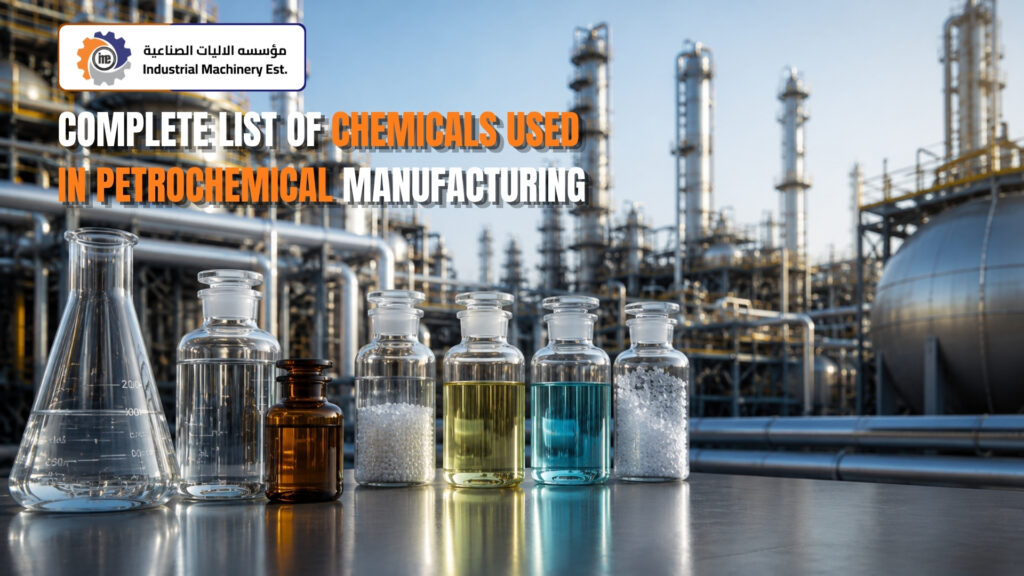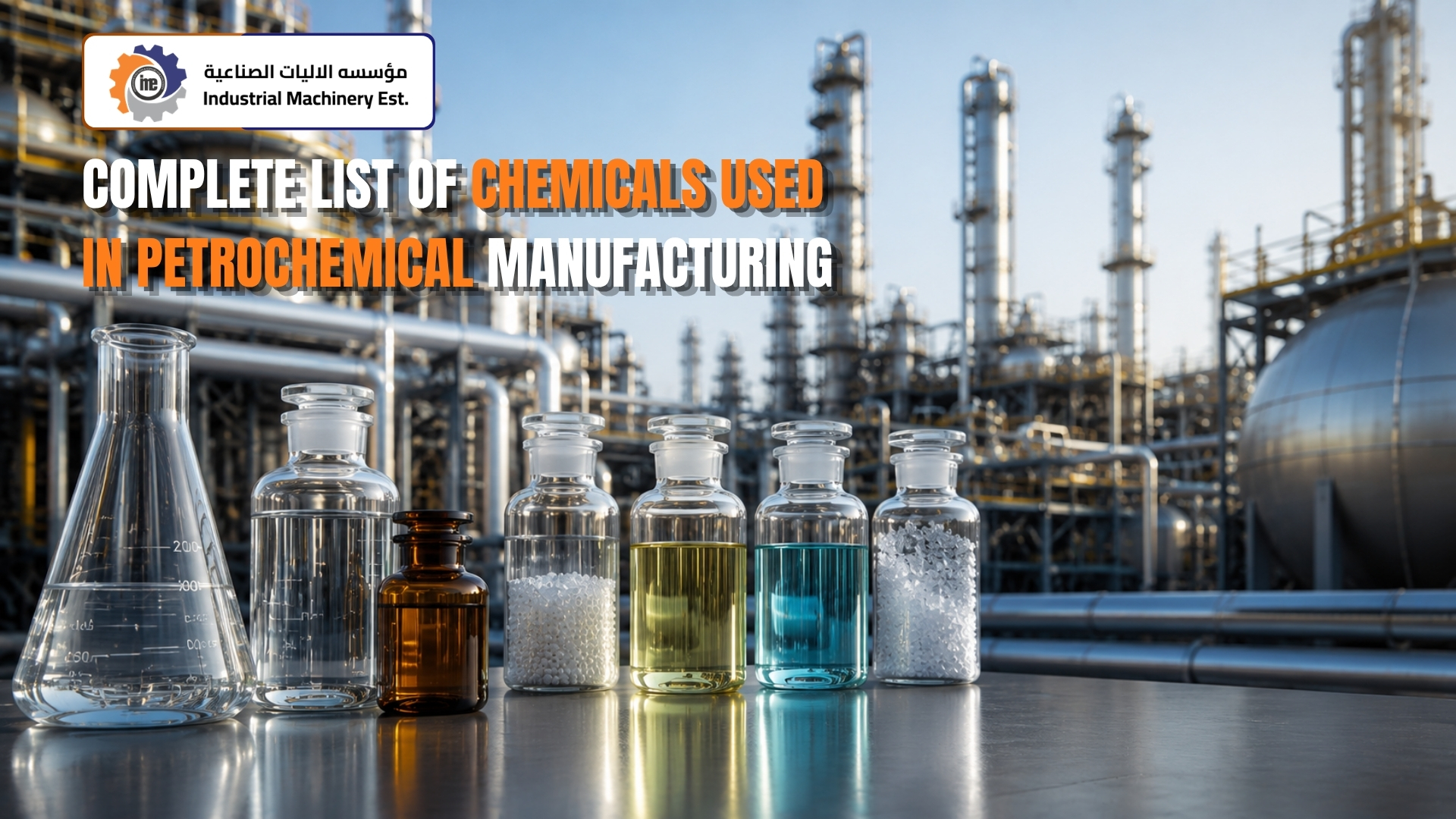
A single complex can run on hundreds of compounds, and mixing up their roles gets expensive fast. Procurement orders the wrong grade. A new engineer confuses a feedstock with a process additive. A maintenance crew reaches for an acid that attacks the very alloy it was meant to protect. Most online lists do not help, because they either stop at ethylene and benzene or bury you in molecular diagrams.
Here is the short version. Almost every one of the chemicals used in petrochemical manufacturing falls into four groups: feedstocks, primary building blocks, derivatives, and process chemicals that protect the equipment rather than make the product. Learn those four groups and any unfamiliar drum label becomes easy to place.
The rest of this article breaks down each group with real names, real applications, and the handling notes that actually matter on site.
Why Plants Depend on So Many Compounds
A petrochemical plant is not one process. It is a chain of them. Feed enters at one end, gets split, cracked, reformed, and polymerised, then leaves as pellets, fibres, or bulk liquids.
Every step needs its own inputs. Some become part of the final product. Others never appear in it and exist only to keep furnaces clean, water stable, and steel intact. That split explains why the chemicals used in petrochemical manufacturing look so scattered at first glance.
Group 1: Feedstocks
Feedstocks are the raw material entering the plant. They are hydrocarbon streams rather than pure compounds, and the choice of feed shapes everything downstream.
- Naphtha: the dominant cracker feed worldwide, especially in Asia and Europe
- Ethane and propane: lighter feeds favoured in the Gulf region because of cheap associated gas
- Butane and condensate: used for blending and specific derivative routes
- Natural gas: the feed for synthesis gas, ammonia, and methanol
- Gas oil: heavier cracking feed, generally less economical
Ethane crackers give a cleaner ethylene yield with fewer by-products. Naphtha crackers give a wider slate, including propylene and aromatics, which is why product mix varies between regions.
Group 2: Primary Building Blocks
These high-volume intermediates come straight out of crackers and reformers. Almost everything else is built from them.
Olefins:
- Ethylene, the highest-volume organic chemical made anywhere
- Propylene
- Butadiene and butylene
Aromatics, often called the BTX group:
- Benzene
- Toluene
- Xylene, including the paraxylene isomer
Synthesis gas products:
- Ammonia
- Methanol
- Hydrogen and carbon monoxide
Roughly half of all ethylene becomes polyethylene. Benzene feeds styrene and phenol routes. Paraxylene feeds the polyester chain.
Group 3: Derivatives and Intermediates
Here the list expands quickly. Derivatives are made from building blocks, then converted again into finished materials.
- Ethylene glycol: antifreeze and polyester fibre
- Ethylene oxide: surfactants and glycol production
- Ethylene dichloride and vinyl chloride: the route to PVC
- Styrene: resins, synthetic rubber, and polystyrene
- Acrylonitrile: synthetic fibres and ABS plastic
- Acetic acid and acetone: solvents and pharmaceutical inputs
- Phenol and cumene: engineering plastics
- Polyethylene, polypropylene, and polyester: the finished polymers
Group 4: Process and Support Chemicals
This group never leaves with the product and is the one most often missing from published lists, yet it drives a large share of reliability spend.
Catalysts and additives:
- Platinum and palladium reforming catalysts
- Zeolite cracking catalysts
- Titanium and zinc based polymerisation catalysts
- Phosphoric acid for alkylation and cumene routes
- Nickel passivators for catalytic cracking units
Protection chemicals:
- Corrosion inhibitors such as imidazolines and film forming amines
- Neutralising amines for overhead systems
- Oxygen scavengers such as ammonium bisulfite
- Antifoulants and anti-polymerisation agents for furnaces and quench systems
- Demulsifiers for desalters
Water treatment chemicals:
- Scale inhibitors and dispersants for cooling towers
- Biocides for microbial control
- Coagulants and flocculants for effluent
- Boiler feedwater phosphates and pH conditioners
Cleaning and Turnaround Chemicals
During shutdowns, a different set of chemicals used in petrochemical manufacturing comes into play. Inhibited hydrochloric acid removes carbonate scale. Citric and formic acid handle iron oxide in boilers and exchangers. Caustic soda strips oil and organic residue. Alkaline degreasers and passivation solutions finish the job.
Inhibitor selection matters more than acid strength here. The wrong inhibitor package on stainless or duplex steel causes damage that outlasts the fouling it removed.
Putting the List to Work
Treat this as a map, not a shopping list. When an unfamiliar drum arrives, ask which of the four groups it belongs to. That single question tells you whether it needs product-grade certification, catalyst handling protocols, or simply a compatible storage tank. Getting the chemicals used in petrochemical manufacturing right is less about memorising names and more about matching each compound to its job, its metallurgy, and its safety case. For chemical cleaning, water treatment, and industrial chemical supply in Jubail and the Eastern Province, Industrial Machinery Est. supports operators across the petrochemical, refining, and power sectors.