Choosing the wrong chemical for a process can cost far more than the chemical itself. Fouled heat exchangers, corroded pipework, and failed water treatment programmes often trace back to a product that was never designed for the job. The confusion is fair, because one word covers everything from bulk acid to a precisely engineered additive.
Here is the short answer. Specialty chemicals are sold for what they do, not for what they are made of. They are formulated in smaller batches to deliver a specific effect, such as cleaning, protecting, or stabilising a process. If you want the full picture, including the main types, real industrial uses, and how to choose the right product, read the complete article below.
Chemical Supplier Company in Saudi Arabia
Specialty Chemicals: A Simple Definition
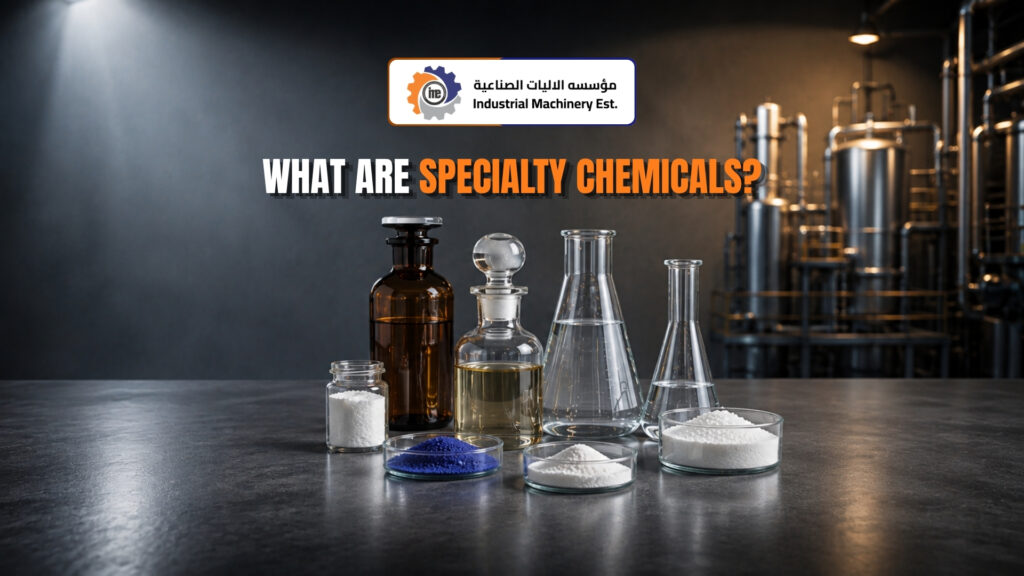
Specialty chemicals are also called performance chemicals or effect chemicals. The name tells you everything. You buy specialty chemicals for the result they create inside a system, not for a chemical formula on a label. A corrosion inhibitor is judged by the metal loss it prevents.
Specialty Chemicals Versus Commodity Chemicals
Commodity chemicals are produced in huge volumes to a fixed standard and sold mainly on price. Specialty chemicals are the opposite. They are made in controlled batches, often blended for one industry or customer, and priced on the value they add. The key differences are simple:
- Volume: bulk production versus small, controlled batches
- Selling point: composition versus proven performance
- Formulation: standard grade versus tailored blends
- Support: minimal versus technical guidance and testing
Main Types of Specialty Chemicals
The category is wide, but most specialty chemicals fall into a few familiar families:
- Cleaning and descaling agents used in chemical cleaning of exchangers, boilers, and tanks
- Corrosion inhibitors and passivating agents that protect metal surfaces
- Surfactants, degreasers, and dispersants that lift oil, sludge, and deposits
- Water treatment chemicals including scale inhibitors, biocides, and oxygen scavengers
- Additives such as defoamers and demulsifiers
- Coatings, adhesives, and sealants that add durability
Where Specialty Chemicals Are Used Every Day
In refineries and petrochemical plants, specialty chemicals keep exchangers clean and prepare systems before start up. In power and utility plants, they control scale and microbial growth in cooling water circuits. In marine terminals, they support tank cleaning and spill response. Outside heavy industry, the same logic applies in pharmaceuticals, food processing, agriculture, and personal care.
Why the Right Choice Protects Your Plant
A well matched specialty chemical removes deposits without attacking base metal, which is exactly what a poor match fails to do. Wrong selections lead to tube thinning, gasket damage, and longer shutdowns. Correct selection of specialty chemicals shortens cleaning time, restores heat transfer, and extends equipment life. The chemical cost is small next to the downtime it prevents.
Must Read: How to Reduce Chemical Procurement Costs in 2026?
How to Select the Right Specialty Chemicals
Never buy on price alone. Start with the problem, not the drum:
- Identify the deposit or contaminant through analysis, not assumption
- Confirm compatibility with metallurgy, gaskets, and operating temperature
- Ask for the Safety Data Sheet and clear dosing instructions
- Run a laboratory or coupon trial before a full application
- Plan neutralisation, disposal, and effluent handling in advance
Handling, Storage, and Safety
Because they are concentrated, specialty chemicals need proper storage, ventilation, containment, and trained handlers. Keep incompatible products separated, label everything clearly, and keep spill kits and protective equipment within reach.
The Bottom Line
Specialty chemicals are problem solvers in liquid or solid form. When they are selected on evidence and applied by trained teams, they protect assets, cut downtime, and improve process efficiency across every industrial sector.
Are specialty chemicals the same as fine chemicals?
No. Fine chemicals are pure single molecules made to a defined specification, often for pharmaceutical use. Specialty chemicals are usually blends judged on performance in service.
How long do specialty chemicals stay usable?
Most carry a shelf life of one to two years when kept sealed, cool, and out of sunlight. Always confirm storage conditions on the Safety Data Sheet.
Can one product clean every type of deposit?
No. Scale, oil, coke, and biofilm each need different chemistry, so deposit analysis should always come before product selection.